The law is a living system as it reflects the society it governs. New legislation is passed, existing legislation is amended, provisions substituted, and frameworks repealed and replaced. This is not a flaw — it is the system working as it should.
But for lawyers, this creates a practical challenge that sits at the heart of good legal practice. The ability to place two versions of the law side by side – when a dispute arose, what it says now, or what it will say when a matter comes before the court – and see exactly what has changed. That comparison is what separates confident advice from guesswork.
The question is not whether the law changes; it always has and always will. The question is how New Zealand lawyers navigate that change with confidence and precision.
The Three Dimensions of Time in Legal Practice
For New Zealand lawyers, navigating legislation across time falls into three distinct scenarios. In each, the critical skill is the same: comparing the law as it was at one point in time against the law at another.
1. Looking back — comparing the past to today
The most fundamental principle of time-specific legal work is this: the date of the event, not the date of the advice, determines which law applies. A lawyer needs to place the version of the law that existed at the time of the event directly alongside the current version — and see, clearly what is different.
Consider a criminal matter involving conduct that occurred before 26 May 2026. Section 106 of the Sentencing Act 2002 was amended on that date by the Crimes Legislation (Stalking and Harassment) Amendment Act 2025, introducing new orders a court may make when discharging an offender. A defence lawyer must compare the prior version of section 106 against the amended version — not just to confirm which one applies, but to understand precisely what the amendment added and whether that distinction matters to the client’s case.
The same principle applies in employment law. A dispute about conduct or an employment relationship that arose under an earlier version of the Employment Relations Act 2000 must be assessed against the rights and obligations that existed at that time. Comparing that earlier version against the current Act allows the lawyer to identify exactly where the legal landscape has shifted — and where it has not.
2. Understanding Change — Comparing any two versions
In many matters, the central legal question is not simply which version of the law applies, but what exactly changed between two versions and why that change is legally significant.
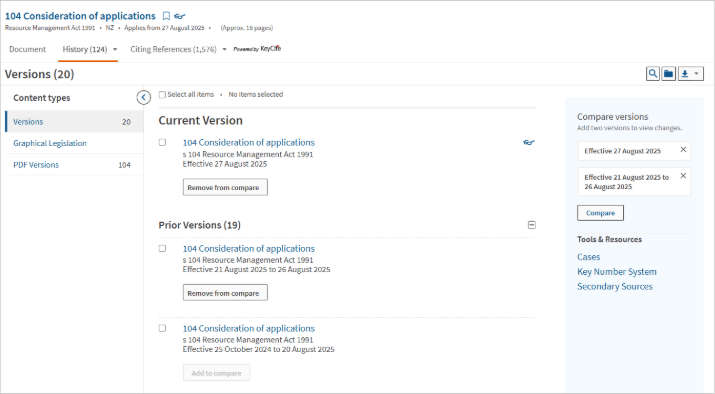
New Zealand’s Resource Management Act 1991 provides a clear illustration. Subsections (2D) and (2E) of section 104 were replaced on 27 August 2025. For any lawyer working on a resource consent matter comparing the version of section 104 before that date against the version that exists after it is not optional. The legal test that applied was materially different on either side of that date, and only a direct comparison of the two versions reveals exactly how and why.
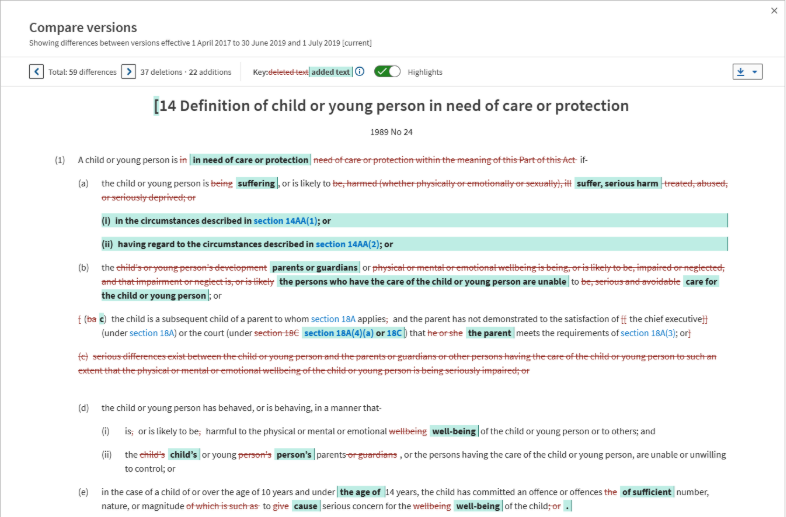
Family law presents another dimension. Section 14 of the Oranga Tamariki Act 1989, was substituted in its entirety as of 1 July 2019. A lawyer working with case law that straddles that date needs to compare the pre- and post-substitution versions to understand whether the decisions they are relying on were made under the same legal test that applies today. Only by comparing the two versions can a lawyer know how much weight to place on any given authority.
3. Looking Forward — Comparing today against what’s to come
The third scenario is prospective. Lawyers advising clients on compliance, strategic business decisions, or upcoming litigation need to compare the law as it currently stands against the law as it will stand once a pending amendment comes into force.
Advising on the current version of a provision without comparing it against the incoming one risks giving advice that is out of date by the time it matters.
Section 36 of the Children’s Act 2014 has a future amendment pending. Comparing the current version of that section against the future version — placing them side by side — is what allows a lawyer to advise with confidence on an application that will be heard after the amendment comes into force.
The complexity deepens when related provisions are also changing, with section 35(1) of the same Act to be substituted in October 2026. Without direct comparison across all versions, the risk of missing something material is real.
Every Version. Every Change. Every Time.
Each scenario comes down to the same practical requirement: the ability to place two versions of the law side by side and see precisely what is different. For too long, meeting that meant significant manual effort and time with the risk of missing something material.
Westlaw New Zealand Statutes Compare solves exactly this problem. Any two versions of New Zealand legislation can be placed side by side with every addition highlighted in green and every deletion marked in red. Individual changes can be navigated one by one, and the marked-up comparison can be downloaded directly into a file note or attached to client advice. What once required 45 minutes of careful manual effort can now be done in seconds.
Statutes Compare is available to all Westlaw New Zealand subscribers, underpinned by New Zealand’s most sophisticated legislation offering, including historic, current, and future legislation versions.
The law will keep changing. Statutes Compare means you will always know exactly how.
Existing Westlaw NZ subscribers: your Statutes Compare training guides, how-to videos, and live webinar sessions are ready.
Not yet on Westlaw New Zealand? Book a demo