When a judge builds a decision, the reasoning rarely travels in a straight line from one authority to the next. Courts draw on a web of related cases — decisions that deal with the same principle, apply the same test, or grapple with similar fact patterns — whether or not those cases have ever directly cited each other. A series of decisions may develop the same principle under different statutory frameworks without ever intersecting through direct citation.
Traditional citation tools cannot reflect this reality. They are built around a single fixed point — your anchor case — and they surface only what explicitly cites it, or what it explicitly cites. Everything outside that direct chain is invisible, even when courts and practitioners consistently treat it as connected.
The Cases You Can’t See
Your anchor case sits at the centre of what you can see. But the cases that matter to your argument may sit just outside that frame — not because they are obscure, but because of how they relate to your authority. Understanding those relationships is where the real gaps emerge.
1. Cited to or cited by
The first gap sits closest to your anchor and cases appears connected at first glance. Cases that your anchor has cited, or that have cited your anchor. The fact that they keep appearing together in legal research signals something more: courts are treating this cluster of authority as a unit.
2. Cited alongside
The second gap is less visible. These are cases with no direct citing relationship to your anchor case at all — cases cited alongside it by a third case, but where neither your anchor case nor this case have ever cited each other. Courts are treating them as connected.
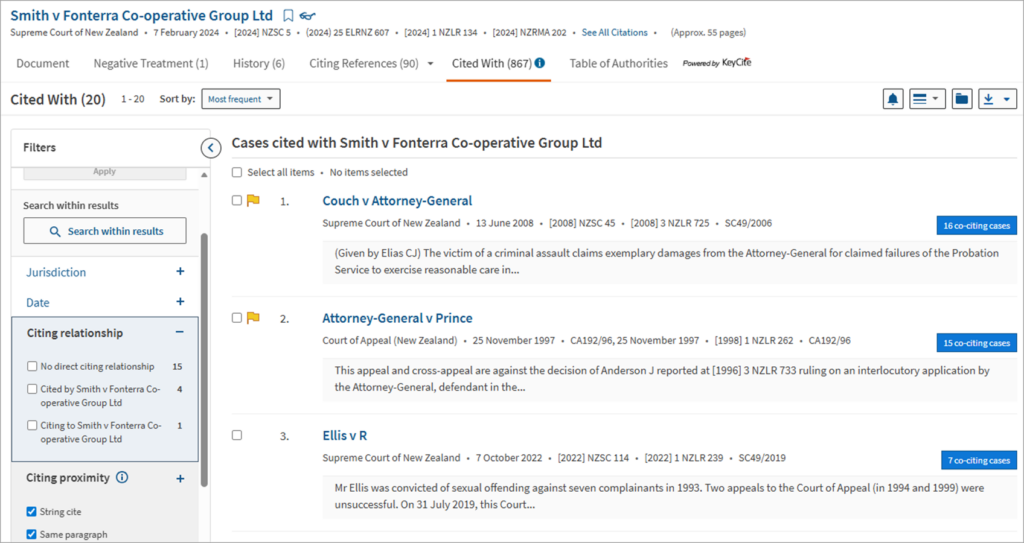
By accessing the Cited With tab, a user can see a list of cases commonly cited alongside Smith v Fonterra, ordered by citing proximity by default. For example Couch v Attorney-General is cited alongside Smith v Fonterra by 16 other cases.
3. Co-cited
The third gap widens the search. Co-citing cases are cases that cite both your anchor case and a specific related case simultaneously, revealing which authorities courts have treated as inseparable on a given point of law.
The value of co-cited cases lies in uncovering the hidden connections between cases that previously could not be identified. Rather than being limited to a Table of Authorities or Citing References, a lawyer can now expand their research to include cases that discuss similar points of law, which provides them with further case law support for submissions to bolster their arguments or uncover a new angle to argue from.

After selecting the Co-citing cases button, the user can see a list of the 16 cases which have cited Smith v Fonterra and Couch v Attorney-General. The respective cases are highlighted in different colours and clicking on the hyperlinks takes you directly to the paragraphs where the cases are cited alongside each other.
Finding the Full Web of Authority
KeyCite Cited With is built specifically for this problem. When you open a case on Westlaw New Zealand with the Cited With tab it surfaces cases that are frequently cited alongside it in legal research — cases that courts and practitioners consistently treat as related, even where no direct citation exists between them.
The results are ranked by citation proximity. Cases cited in the same sentence as your anchor case — a string cite — appear first, followed by those cited in the same paragraph. That ranking is not arbitrary. Citation proximity is a strong signal of how courts are treating these cases in relation to each other, and the closer the citation, the stronger the signal that they are being treated as connected on the same point of law.
Each of the citing relationships is visible as a distinct filter within the Cited With tab, allowing you to move through the different layers of connection — from the cases closest to your anchor, outward to those with no direct citing relationship, and further still to the co-citing cases that reveal how the full web of authority holds together. The research builds naturally, with every result hyperlinked so the chain of inquiry never breaks.
How it Fits Your Workflow
KeyCite Cited With is not a replacement for your existing citation research — it is the next step. Your natural starting point remains the same: find your anchor case, run your standard KeyCite check, review what cites it and what it cites. KeyCite Cited With picks up from there. Once you have your anchor, open the Cited With tab to see the broader cluster of authority courts have consistently treated as connected to it.
Think of it as the difference between knowing the cases on your immediate reading list and knowing the full body of authority a senior partner would expect to see addressed in a memo. The two tools work in sequence, not in competition.
Existing Westlaw NZ subscribers: your training guides, how-to videos, and live webinar sessions are ready.
Not yet on Westlaw New Zealand? Book a demo